
5 Minute Read
Prepare Your Heart
To the best of your ability, get rid of all distractions. Take a few minutes to breathe deeply and quiet yourself in the Lord’s presence. Then, ask the Lord to speak to you in this time. Let Him know that you will listen and make whatever adjustments He will reveal to you.
Read God’s Word
Jeremiah 18-20
2 Timothy 1:1-2:13
A Verse for Today
Slowly and reflectively read the following verse(s) and listen to what God will say to you through His written Word. Consider writing down any insights He reveals to you.
Jeremiah 19:5-6 (CSB): “They have built high places to Baal on which to burn their children in the fire as burnt offerings to Baal, something I have never commanded or mentioned; I never entertained the thought. Therefore, look, the days are coming—this is the LORD’s declaration—when this place will no longer be called Topheth and Ben Hinnom Valley, but Slaughter Valley.”
Reflecting on God’s Word
On Saturday, June 2, 2018, Kim and I gathered with a large group of other tourists for a final meal together. We had spent the previous week exploring much of Israel. On this Saturday evening, we enjoyed a wonderful meal together as we all prepared to hop on planes the next day and head back to our home countries.
As we ate at the Lavan, near the Old City of David, I took a picture out the window beside my table. We had seen more sand and rocks than I ever imagined in our travels the previous week. But the scenery outside my window was lush and green with plenty of grass and trees.
I captured the picture below and then used my phone to discover where we were. Our week in Israel required no previous knowledge of each location. We simply hopped on the bus, let the driver take us to our next stop, and then listened to our tour guide explain where we were and the significance of the location. But on this occasion, our tour guide didn’t tell us about our location because it wasn’t deemed important, aside from being the place where we enjoyed our final meal.
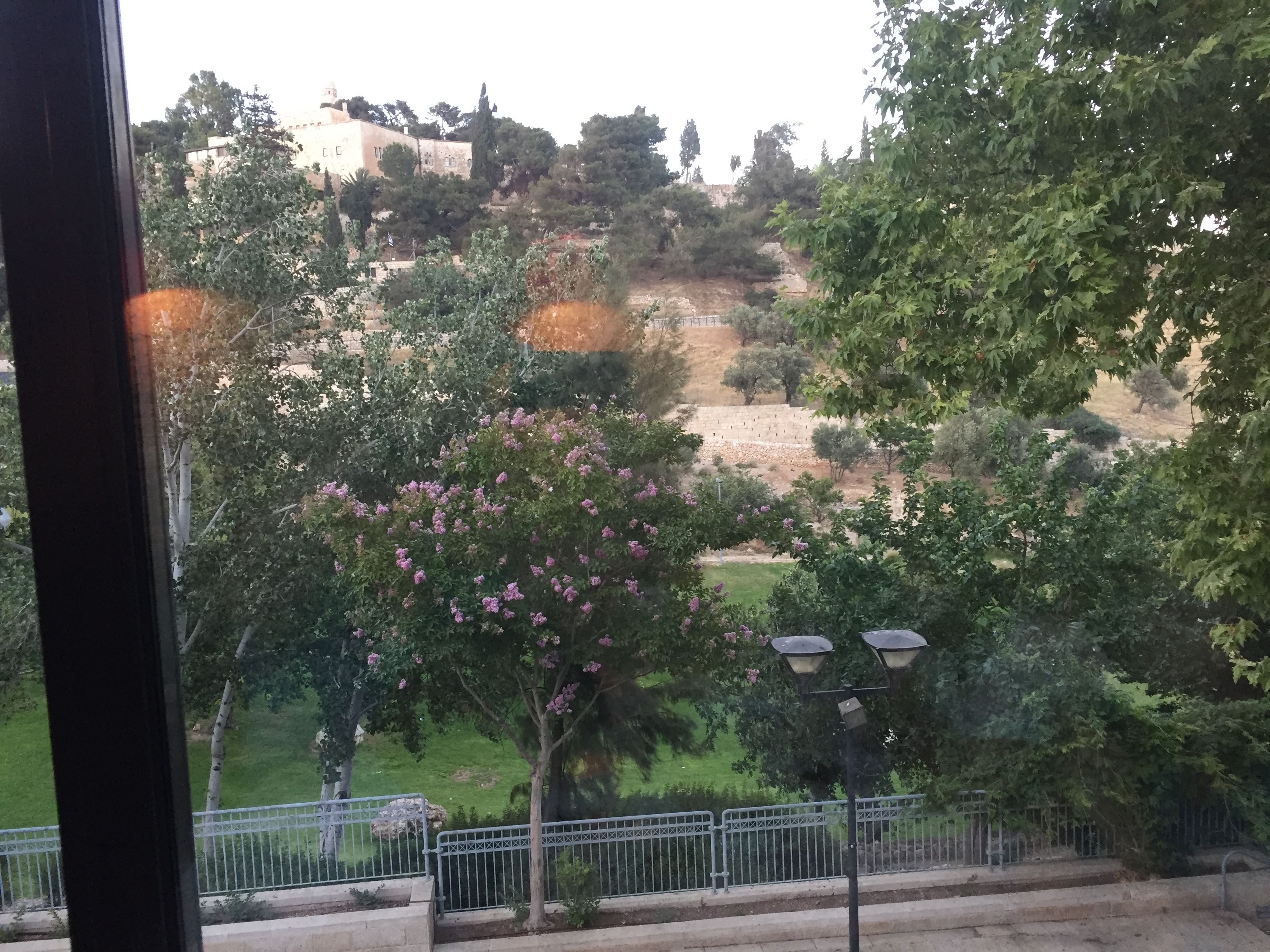
As I looked at my phone, I noticed that the vehicles on the other side of the park were traveling on Gey Ben Hinnom Road. And that’s when it hit me! We were eating supper in the Valley of Hinnem. We were in Gehenna!
This was the location that God spoke of to Jeremiah in the verses I chose for today. It’s the place where Old Testament Israelites strayed so far away from the Lord that they embraced the practices of the Canaanites who inhabited the land before Joshua claimed it. They burned their children alive as sacrifices to Molech.
The events of this valley were so horrific that Jesus used “Gehenna” as the emotionally charged word to describe what Hell will be like. Here are a few places that Jesus used the word.
Matthew 5:22 (CSB): “But I tell you, everyone who is angry with his brother or sister will be subject to judgment. Whoever insults his brother or sister, will be subject to the court. Whoever says, ‘You fool!’ will be subject to hellfire.” (“hellfire” is the word “gehenna”)
Matthew 5:29 (CSB): “If your right eye causes you to sin, gouge it out and throw it away. For it is better that you lose one of the parts of your body than for your whole body to be thrown into hell.” (“hell” is the word “gehenna”)
Matthew 10:28 (CSB): “Don’t fear those who kill the body but are not able to kill the soul; rather, fear him who is able to destroy both soul and body in hell.”
These are only a sampling of the instances in which Jesus used “gehenna” to describe the place of the unrighteous dead.
Why? Why would Jesus use “Gehenna” as a descriptive word for Hell?
Because so much of the experience in the Valley of Hinnom in Jeremiah’s day will be similar to what people experience in Hell forever. Here are a few things that are similar:
- It’s a place of fire
- It’s a place of unimaginable physical torment (children burning to death in the fire)
- It’s a place of stench (burning flesh)
- It’s a place of hatred (parents don’t love; they heartlessly kill their own children)
- It’s a place utterly devoid of hope (no one will help, no matter how pitiful the cries are)
- It’s a place where the vulnerable aren’t protected – they are exploited
- Etc., etc., etc.
By the time Jesus walked the streets of Jerusalem, the Valley of Hinnom had become the city dump. It wasn’t worth salvaging. But the first-century Israelites hadn’t forgotten what had happened there. And that’s why Jesus used such an emotionally charged word to describe the eternal home of the unrighteous dead.
He was using it as a warning. He was warning us that we don’t dare want to miss Heaven by spending eternity in Hell.
Spend Time in Prayer
- Ask God to help you realize just how horrific Hell will be.
- Ask God to enable you to be restfully available to Him, ready for any opportunity to share the good news of the Gospel with others.
Going Deeper
If you want to dig a little deeper into Jesus’ use of the word Gehenna, consider reading the following GotQuestions article:
Sharing
If this post has been helpful to you or if you think it could help others, please consider tapping one of the social media buttons below to share it on your favorite platform.
____________________
Matt Ellis is the pastor of White Hall Baptist Church in Richmond, Kentucky (whitehallbaptistchurch.org)
 Matt’s Musings